
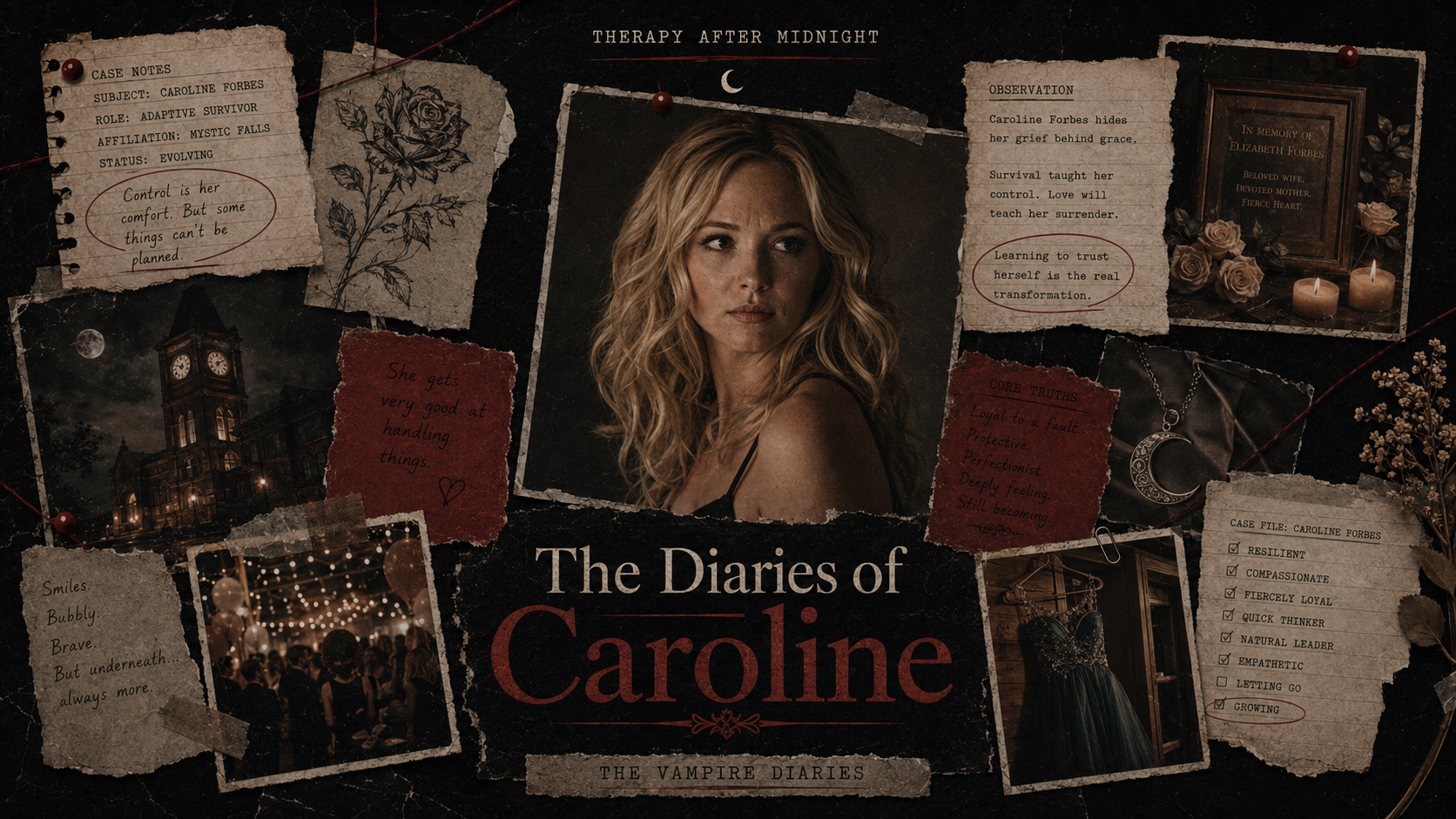
Therapy After Midnight | The Mystic Falls Diaries
Spoiler note: This entry discusses Caroline Forbes across all eight seasons of The Vampire Diaries.
Caroline Forbes has always been one of those characters I appreciated more as the series went on.
At the beginning of The Vampire Diaries, she can be a lot. She wants things organized. She wants to know what is happening. She wants people to follow the plan she already made. She compares herself to Elena, worries about whether people like her, and sometimes tries way too hard to prove that she belongs.
Then she becomes a vampire.
Strangely, this thing that should completely throw her life into chaos is also where Caroline starts becoming more comfortable with herself.
I do not think becoming a vampire magically fixes her insecurity. I think it gives her something she did not always feel like she had before: a sense that she could handle herself.
That becomes one of the most interesting parts of Caroline’s story for me.
She gets very good at handling things.
The question is what happens when handling things becomes the way you deal with almost everything.
Caroline Spends a Lot of Time Comparing Herself to Other People
Early Caroline does not seem to trust that she is enough on her own.
Elena gets Stefan.
Elena seems to get attention without trying very hard for it.
Caroline notices.
She wants reassurance. She wants to be included. She wants to feel attractive, important, and wanted.
I do not say that as a criticism of her. Most teenagers are trying to figure out who they are while also paying a lot of attention to how other people see them.
Caroline just seems especially sensitive to it.
That is part of why perfectionism feels like a useful way to think about her.
Perfectionism is not simply being organized or having high standards. The more difficult part is when mistakes, criticism, or someone else’s opinion start carrying too much weight in how you see yourself.
Caroline often seems to want proof that she is doing things right.
If the event is perfect, she did her job.
If everyone is happy, she did her job.
If she looks good enough, performs well enough, and keeps things moving, maybe she does not have to spend as much time wondering whether she is enough.
What Damon Does to Caroline Should Not Get Lost
Caroline’s early relationship with Damon is something I think the series moves past faster than I would like.
She is initially interested in him.
Then Damon starts feeding on her, frightening her, compelling her, using her, and controlling what she remembers.
There is obviously no real-world equivalent to vampire compulsion.
What is real is the issue of agency.
Caroline loses the ability to make informed choices about what is happening to her.
Damon can make her forget things she would otherwise remember. He can influence whether she stays, leaves, or resists him.
That matters.
Later, when Caroline becomes a vampire, she remembers what happened and confronts him. The show acknowledges it, but it rarely gives Caroline much room to actually process what that experience meant.
I would not explain everything Caroline does afterward through Damon. Her character is much bigger than something that happened to her early in the series.
I also would not pretend it has no relevance.
Caroline begins the show already struggling with confidence and control. Then someone takes control away from her in one of the most extreme ways the supernatural world allows.
Somehow, Caroline Is Really Good at Being a Vampire
Caroline does not choose to become a vampire.
Katherine kills her while Damon’s blood is in her system, and Caroline wakes up having to understand a completely different body and life.
At first, she is terrified.
She feeds.
She kills someone.
She does not know what is happening to her.
Then Stefan starts helping her.
And Caroline learns.
This might be one of my favorite things about her character.
Once she understands the rules, she becomes incredibly disciplined.
She learns how to control her feeding. She learns how to fight. She becomes physically stronger and much harder for people to dismiss.
For someone who spent so much time feeling like everyone else had something she did not, being competent seems to change her.
She does not suddenly stop caring what people think.
She just starts having more evidence that she can trust herself.
That feels different.
Being Controlling Is Not the Same Thing as Having OCD
Caroline is also a useful character for talking about a mental health term that gets used pretty casually.
She likes things organized.
She likes plans.
She can be very particular.
She can absolutely become controlling.
That does not mean she has obsessive-compulsive disorder.
OCD involves obsessions, compulsions, or both, and those symptoms typically cause significant distress or interfere with someone’s life.
Wanting the party decorations arranged correctly is not enough.
Neither is liking lists.
Neither is wanting people to follow your plan.
Caroline does not need an OCD diagnosis for her relationship with control to be interesting.
I am much more interested in what control seems to do for her.
Sometimes it helps her get things done.
Sometimes it gives everyone around her structure.
Sometimes it probably makes her feel safer.
And sometimes I think it keeps her moving when slowing down would mean feeling something she does not know what to do with.
Then Her Mom Gets Sick
Liz Forbes becomes one of the most important relationships in Caroline’s life.
Their relationship is not perfect, especially when Liz first learns what Caroline has become, but they eventually grow very close.
Then Liz gets cancer.
Mystic Falls has spent years teaching Caroline that there is usually another option.
There is another spell.
Another loophole.
Another supernatural person who might know something.
Death is surprisingly negotiable in this town.
Cancer is different.
Caroline researches.
She tries vampire blood.
She looks for something she can do.
And eventually she has to face the fact that she cannot organize her way out of losing her mother.
For someone like Caroline, I think that matters almost as much as the grief itself.
She is used to being able to do something.
There is no checklist that makes Liz survive.
Turning Off Her Humanity Feels Very Caroline
After Liz dies, Caroline decides to turn off her humanity.
But even this is organized.
She has a plan.
She wants one year.
She wants to keep going to school.
She does not initially intend to become completely reckless.
She believes she can remove grief and continue functioning.
That might be the most Caroline Forbes approach to emotional avoidance imaginable.
I would not try to translate the humanity switch directly into a real clinical symptom. It is supernatural.
As a metaphor, though, it works.
Caroline does not want to deal with what she is feeling, so she tries to remove her ability to feel it.
I can understand the wish.
There are times when grief feels so overwhelming that not feeling anything sounds easier.
People do need breaks from grief. We distract ourselves. We watch television. We work. We spend time with friends. We sleep. We laugh at something stupid and then sometimes feel guilty for laughing.
None of that is automatically avoidance.
The problem is when the goal becomes never having to feel the loss.
Caroline does not want a break from grief.
She wants grief gone.
She Cannot Turn Off Only the Part That Hurts
The problem is that Caroline cannot remove grief while keeping every other part of herself exactly the same.
Her compassion changes.
Her relationships change.
The way she thinks about consequences changes.
Eventually, the control she thought she could maintain starts falling apart.
She hurts people.
She manipulates Stefan.
She threatens people she loves.
Understanding why Caroline wants the pain to stop does not excuse any of that.
It does make the storyline more human.
She does not turn off her humanity because she suddenly stops caring about everyone.
She turns it off because she cared so much about one person that losing her felt unbearable.
Liz’s Letter Is One of the Hardest Parts of the Story
Before Liz dies, she writes Caroline a letter.
While Caroline’s humanity is off, Stefan destroys it after Caroline tells him to.
Later, when Caroline can feel again, she wants the letter back.
It is gone.
I think that moment works because grief is full of things like that.
There are conversations we wish we could have had.
Questions we think of afterward.
Voicemails we suddenly care about.
Objects that seemed ordinary until the person attached to them was gone.
Mystic Falls gives characters a lot of second chances.
The letter does not get one.
Caroline has to live with it.
Caroline Never Stops Being Caroline
One thing I like about her ending is that growth does not turn her into a completely different person.
She still organizes.
She still takes charge.
She still notices details.
She becomes a mother to Lizzie and Josie, and eventually she helps create a school for supernatural children who are trying to understand what they are.
That feels fitting.
Caroline spent part of her adolescence trying to figure out what was happening to her and whether there was something wrong with her.
Later, she helps create a place where other kids do not have to figure that out alone.
Her competence becomes something she can use without needing it to prove that she deserves to be there.
At least, that is how I like to read it.
So What Would I Diagnose Caroline With?
I would not diagnose Caroline based on the series.
She experiences coercion, violence, huge identity changes, grief, repeated losses, relationship stress, and more supernatural trauma than any person should reasonably have to fit into eight seasons of television.
She is also perfectionistic, rigid sometimes, deeply caring, resilient, anxious about how others see her, and extremely capable.
All of that gives us plenty to talk about without assigning a disorder.
For me, the more interesting question is what Caroline does when she feels like life is getting away from her.
She organizes.
She takes care of people.
She researches.
She makes a plan.
Most of the time, those are strengths.
But there are things a plan cannot fix.
Liz’s death is one of them.
That may be where Caroline grows the most.
Not because she learns to stop caring about control, but because she eventually learns that some things have to be lived through rather than solved.
Before You Leave Mystic Falls
Think about what you tend to do when things feel uncertain.
Do you make a plan?
Stay busy?
Take care of everyone else?
Research until you feel like you understand everything?
There is nothing automatically unhealthy about any of those things.
I think the better question is whether they are helping you move through what you feel or helping you stay far enough away from it that you do not have to feel it yet.
Sometimes it is a little of both.
Return to The Mystic Falls Diaries
Therapy After Midnight looks at fictional characters through a mental health lens. These posts are educational reflections, not actual clinical diagnoses. Fiction does not provide the assessment, history, collateral information, or therapeutic relationship required for diagnosis.
Research notes
- Primary continuity for this entry is the television series The Vampire Diaries, not the original novel continuity.
- Storylines considered include Caroline’s early insecurity, Damon’s use of compulsion, her transition into a vampire, Stefan helping her learn control, her relationship with Liz Forbes, Liz’s cancer and death, Caroline turning off her humanity, Liz’s letter, motherhood, and the Salvatore School.
- Damon’s compulsion is discussed through agency and consent rather than used as evidence for a trauma diagnosis.
- Perfectionism is treated as a multidimensional psychological concept rather than a disorder. Research generally distinguishes high personal standards from perfectionistic concerns involving mistakes, evaluation, and self-worth.
- Organization, rigidity, or wanting control are not enough to diagnose obsessive-compulsive disorder.
- The grief discussion is informed by research examining emotion regulation and experiential avoidance after bereavement.
Leave a Reply