
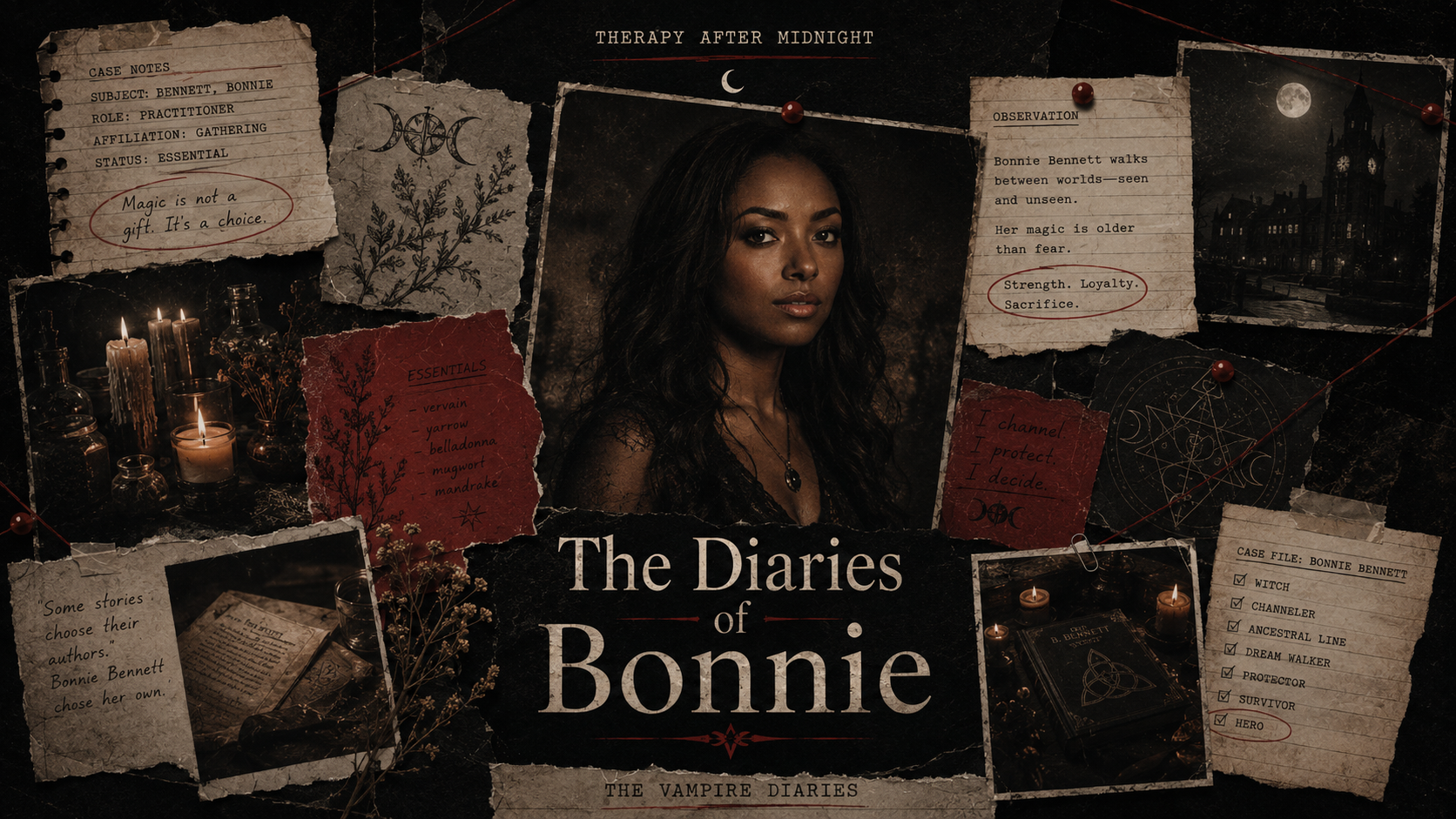
Therapy After Midnight | The Mystic Falls Diaries
Bonnie Bennett is very often the person everyone calls when something impossible needs to be fixed.
There is a spell that needs to be performed. Someone needs to be saved. A supernatural rule needs to be broken. A doorway needs to be opened. Someone has died and the group wants to know whether death can somehow be negotiated with again.
Bonnie becomes so capable that it is easy for everyone around her, and sometimes the story itself, to treat her ability to survive as proof that she can keep surviving anything.
That is what makes her interesting to me psychologically.
Bonnie’s story is not just about resilience. It is also about what can happen when being strong becomes a role you are expected to keep performing, even while you are grieving.
The Bennett Legacy Gives Bonnie Power and Responsibility
Bonnie begins the series as a teenager who does not fully understand what her grandmother is trying to tell her about their family.
Sheila Bennett introduces Bonnie to a much larger history. The Bennett line stretches across generations of witches whose magic has repeatedly shaped Mystic Falls and the supernatural world around it.
That heritage gives Bonnie a sense of identity, but it also gives other people access to something they need from her.
Once Bonnie’s abilities become known, her magic is rarely just hers. Vampires need her. Her friends need her. Other witches need her. Plans begin to depend on whether Bonnie can perform a spell, channel enough power, find another loophole, or survive the consequences.
There is an important difference between being valued and being useful. Bonnie is loved by the people around her, but the series repeatedly places her in situations where those two experiences become difficult to separate.
Grams Is the First Major Cost
Sheila is more than Bonnie’s teacher. She is one of the first people who understands what Bonnie is becoming and can place that experience inside a family history.
When Bonnie and Sheila use their magic to open the vampire tomb, the strain contributes to Sheila’s death. Bonnie does not simply lose her grandmother. She loses her mentor at the same time that she is still learning what it means to be a witch.
That loss also connects Bonnie’s grief to the supernatural world surrounding Elena, Stefan, and Damon. Magic is no longer exciting or abstract. It has a cost, and Bonnie has already watched someone she loves pay it.
From that point forward, Bonnie’s willingness to help vampires is never quite simple. She can love Elena and Caroline while still resenting the danger that entered her life with the Salvatores. Both things can be true.
Bonnie Keeps Losing People While Everyone Keeps Needing Her
One of the most striking things about Bonnie’s story is not any single loss. It is the accumulation.
She loses Grams. Her relationship with her mother is disrupted again after Abby is turned into a vampire. Jeremy dies. Bonnie dies while bringing him back. Later, while Bonnie is a ghost and unable to intervene, Silas murders her father in front of her. She becomes the Anchor to the Other Side and physically experiences supernatural beings passing through her in death. The Other Side collapses. She becomes trapped in a prison world. Years later, she loses Enzo just as the two of them are imagining an actual future together.
Real grief does not operate like a reset button. One loss does not politely finish before another begins.
Research on repeated bereavement suggests that cumulative losses can affect well-being in ways that are not captured by looking at each death separately. Social support can also matter after sudden or violent loss, although grief does not follow one predictable path and support does not erase what happened.
Bonnie often has people around her. What she does not always seem to have is enough space where she is allowed to be the person who needs something.
Dying to Bring Jeremy Back Says a Lot About Her Role
After Jeremy dies, Bonnie becomes desperate to reverse it.
Grief makes the impossible feel worth attempting. In Bonnie’s world, unlike ours, the impossible has also worked often enough that there is always another loophole to search for.
Bonnie succeeds in bringing Jeremy back, but the spell kills her.
The part that stays with me is what happens afterward. Bonnie initially allows her friends to believe she is away rather than telling them immediately that she is dead. Even her own death becomes something she tries to manage for everyone else.
This is where “selfless” starts to feel too simple a word for Bonnie.
Selflessness can be generous. It can also become dangerous when a person learns that their needs are always the easiest ones to postpone.
The Anchor Makes Other People’s Pain Literally Pass Through Her
When Bonnie becomes the Anchor to the Other Side, the show turns one of her long-running emotional roles into something physical.
Every supernatural being who dies and passes to the Other Side must pass through Bonnie. She feels their deaths.
I would not try to translate the Anchor into a diagnosis. It is supernatural.
As a metaphor, though, it is hard to miss. Bonnie becomes the point through which everyone else’s death, pain, and transition travels.
She is not simply witnessing suffering anymore. The system requires her body to absorb it.
That is an extreme fictional version of a very human problem: what happens when someone becomes the emotional infrastructure of a group and everyone gets used to the idea that they will hold whatever the group cannot hold for itself?
The Prison World Is Where Bonnie Starts Choosing Herself Differently
Bonnie and Damon entering the 1994 Prison World changes both characters.
For Bonnie, it is also a prolonged period of isolation, danger, and loss of control. Kai manipulates, attacks, and terrorizes her. Bonnie eventually sends Damon home while she remains behind. Later she is left alone in the prison world and has to find her own way out.
When she returns, she is not simply grateful to be alive.
She is angry. She does not want to forgive Kai because other people find his apology convenient. When Damon pushes her into interacting with him, Bonnie makes him understand what happened to her rather than allowing the conversation to move on before she is ready.
I think this is one of the most important developments in Bonnie’s story.
She does not stop loving people. She starts becoming more willing to say that loving them does not automatically give them access to every part of her.
That is a boundary.
Bonnie and Damon Become Friends When Neither Can Use the Other’s Old Role
Bonnie and Damon begin the series with plenty of reasons to dislike each other.
The Prison World forces their relationship into a completely different shape. They are isolated together, dependent on each other, irritated by each other, and eventually genuinely attached to each other.
What makes that friendship especially interesting is that Bonnie gradually becomes more than Damon’s witch friend who can solve a supernatural problem.
She becomes Bonnie.
He worries about her because she is missing, not only because a spell needs to be done. She challenges him. He disappoints her. They repair some of those ruptures. Their friendship becomes one of the places where Bonnie’s value is less dependent on what she can magically provide.
That does not make Damon consistently good at respecting her boundaries. It makes the moments when he finally does listen more meaningful.
Enzo Gives Bonnie a Future That Is Not About Saving Mystic Falls
Bonnie’s relationship with Enzo matters because it allows the series to imagine her life outside the usual emergency.
They hide from the Armory. They build a relationship over time. They talk about a future. Bonnie is still dealing with supernatural danger, but she also gets to want something for herself.
Then Stefan kills Enzo in front of her.
By this point in the series, Bonnie knows grief extremely well. That does not make the loss easier.
This is important because resilience is sometimes misunderstood as becoming less affected by pain. That is not what resilience has to mean.
A person can survive many losses and still be devastated by the next one.
The Bennett Witches Help Her, but Bonnie Is the One Who Chooses to Live
In the finale, Bonnie faces hellfire and initially tries to hold it back herself.
Then she is joined by Sheila and generations of Bennett witches.
There is something fitting about Bonnie’s final major act of magic not being completely solitary. The Bennett legacy that once felt like responsibility also becomes connection.
But the part of Bonnie’s ending I like most happens after the saving is over.
She breaks the spell linking her life to Elena’s sleep. She packs a bag. She keeps the promise she made to Enzo to live her life. She leaves to see the world.
Bonnie Bennett spends years being the person who makes everyone else’s next chapter possible.
Her ending finally gives her one of her own.
So What Would I Diagnose Bonnie With?
I would not diagnose Bonnie from the series.
She experiences repeated bereavement, violent losses, isolation, captivity, threats to her life, and prolonged supernatural stress. After the Prison World, the show clearly depicts changes in how safe she feels around Kai and how willing she is to tolerate other people ignoring her boundaries.
Those are meaningful things to discuss through a trauma-informed lens. They are not enough to responsibly assign a diagnosis from a fictional narrative.
I think the stronger psychological question is about identity and worth.
What happens when someone becomes so reliable that everyone starts assuming they can keep giving?
And what changes when that person finally decides that protecting their own life is not selfish?
Before You Leave Mystic Falls
Think about the person in a family or friend group who is usually described as “the strong one.”
Then ask a second question: who checks what the strong person needs when there is nothing left for them to fix?
Return to The Mystic Falls Diaries
Therapy After Midnight looks at fictional characters through a mental health lens. These posts are educational reflections, not actual clinical diagnoses. Fiction does not provide the assessment, history, collateral information, or therapeutic relationship required for diagnosis.
Research notes
- Primary continuity for this entry is the television series The Vampire Diaries, not the original novel continuity.
- Lore areas incorporated include Sheila Bennett and the tomb spell, Abby Bennett, Jeremy’s death and resurrection, Bonnie’s death, Rudy’s murder by Silas, the Anchor and collapse of the Other Side, the 1994 Prison World, Kai, Bonnie’s friendship with Damon, Enzo, the Bennett ancestors, hellfire, and Bonnie’s decision to travel after the finale.
- The discussion of trauma intentionally describes experiences and responses rather than assigning Bonnie PTSD or another diagnosis from the series.
- Clinical grounding for the grief sections includes SAMHSA guidance on bereavement and traumatic grief, along with peer-reviewed research on repeated bereavement and the relationship between social support and psychological well-being after sudden or violent loss.
Leave a Reply