
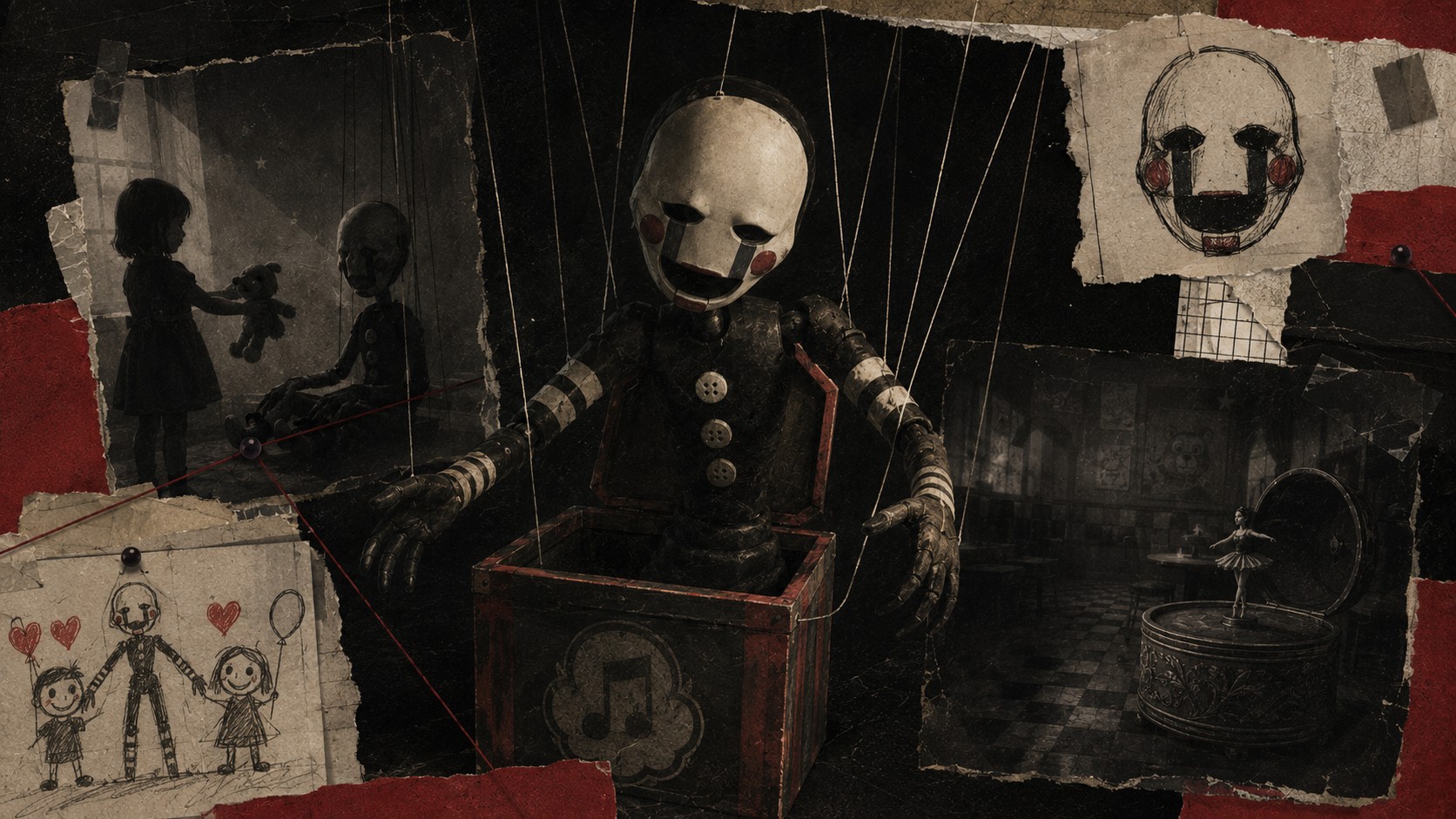
THERAPY AFTER MIDNIGHT
FNAF FILE #003
Archives: The Animatronic Files / The Emily Files
Subjects: The Puppet and Charlotte Emily
Clinical focus: caregiving, identity, responsibility, protection, and childhood
Continuity: Game continuity first
Diagnosis: Not assigned
Spoilers: Major
The Puppet: Protector, Prisoner, or Both?
The Puppet occupies an unusual place in Five Nights at Freddy’s. It is frightening, but its role is not simply that of another monster hunting the player.
Through Charlotte Emily, the Puppet becomes connected with protection, the other murdered children, and the consequences of a child being left without protection herself.
That contradiction is what makes this file worth opening: What happens when the person associated with protecting everyone else was someone who needed protection too?
A Child Who Becomes the Protector
Henry describes his daughter as someone whose nature was to protect the innocent. Within FNAF’s supernatural framework, Charlotte’s role becomes intertwined with the other children.
There is a real psychological concept nearby that is worth discussing carefully. Parentification describes a role reversal in which a child takes on developmentally inappropriate adult or caregiving responsibilities. Research also makes clear that childhood caregiving is not automatically harmful or automatically parentification. Context, burden, developmental appropriateness, recognition, and support matter.
That is why I would not call Charlotte’s supernatural role literal parentification. FNAF does not show us a real-world family role reversal that would justify that conclusion. Her story does, however, give us a useful fictional doorway into a broader question: why do we sometimes admire children for being strong without asking what they needed from the adults around them?
Protection After Being Unprotected
There is something painful about Charlotte becoming associated with protection after her own death occurs when she is isolated and vulnerable.
People can sometimes create meaning after painful experiences by committing themselves to values, relationships, or purposes that matter deeply to them. That does not make trauma necessary, useful, or secretly beneficial. It means meaning can sometimes be built after suffering.
Is the Puppet Charlotte?
This is where psychology has to share the room with FNAF’s supernatural rules.
If a child’s spirit inhabits an animatronic, questions about identity become philosophical as much as psychological. Is the Puppet Charlotte? Is it Charlotte expressed through something else? How much of the behavior belongs to the child, the animatronic, or the supernatural mechanics of the world?
A clinical framework cannot answer that. But fiction can still use impossible circumstances to make us think about identity, memory, responsibility, and what remains of a person after loss.
Canon / Theory Note
This file begins with the game continuity and Henry’s description of his daughter in Freddy Fazbear’s Pizzeria Simulator. The connection between Charlotte and the Puppet is part of that game-continuity discussion, while books and other continuities may expand or alter character histories and should be treated separately.
Reflection
When we praise someone for always being the person who takes care of everyone else, do we ever stop to ask: Who takes care of them?
Sources & Further Reading
- Hooper, L. M., DeCoster, J., White, N., & Voltz, M. L. (2011). Characterizing the magnitude of the relation between self-reported childhood parentification and adult psychopathology: A meta-analysis. Journal of Clinical Psychology, 67(10), 1028–1043. https://pubmed.ncbi.nlm.nih.gov/21563325/
- van der Mijl, R. C. W., Vingerhoets, A. J. J. M., & van Balkom, A. J. L. M. (2022). Parentification, adultification, and infantilization: A systematic review. International Journal of Environmental Research and Public Health. https://pmc.ncbi.nlm.nih.gov/articles/PMC8942130/
Leave a Reply