
Article Review | Counselor’s Canvas
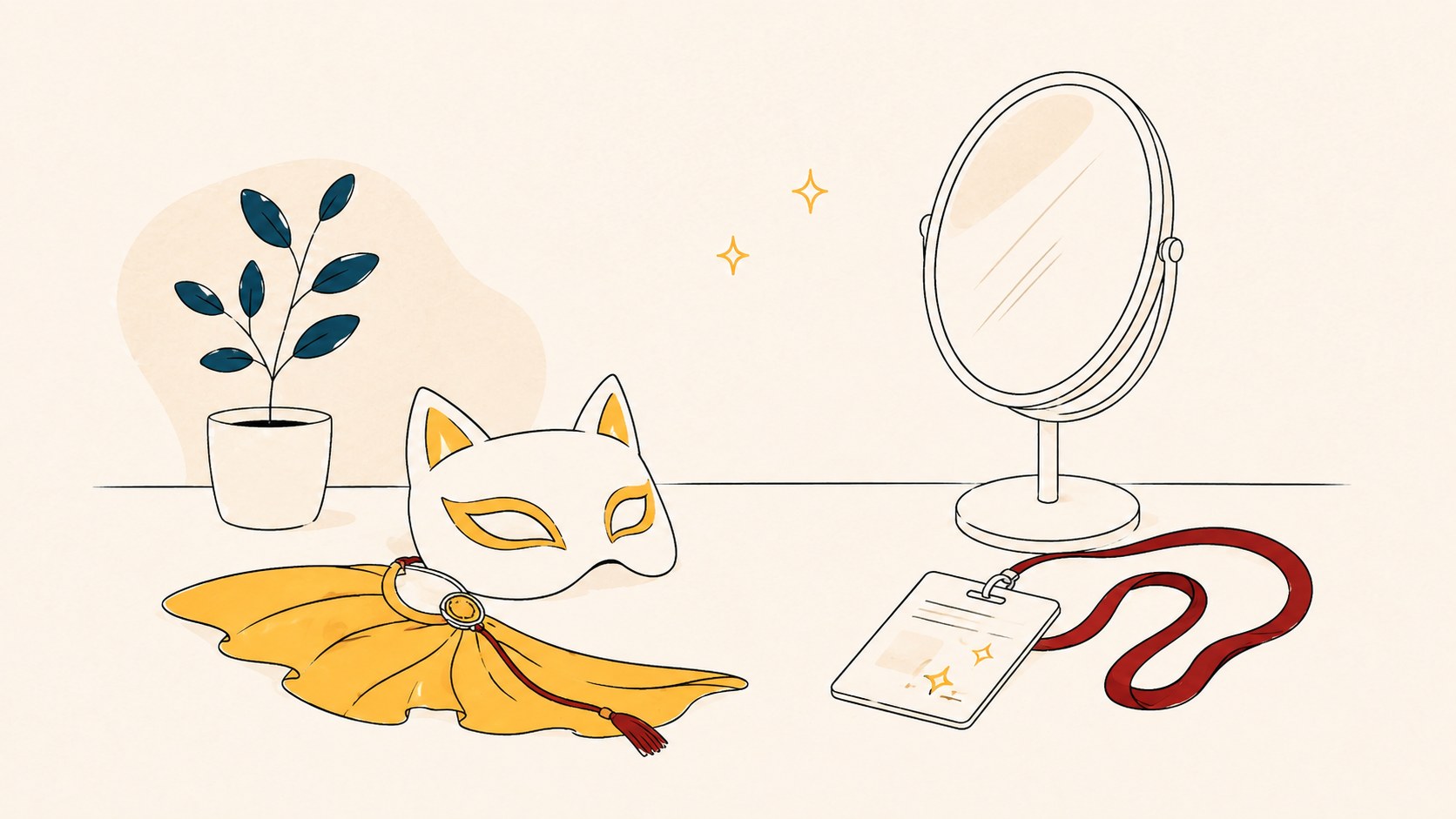
There can be something freeing about entering a convention in costume.
You may still be yourself, but the social rules are temporarily different. People expect unusual clothing. Strangers have obvious conversation starters. Shared interests are visible. A character can give someone a familiar role to step into.
It is tempting to say that cosplay therefore helps Social Anxiety Disorder. The more accurate answer is that psychology gives us several reasons the idea makes sense, while direct research on cosplay as a social-anxiety intervention remains limited.
What Social Anxiety Often Does to Attention
Social anxiety can involve intense concern about being judged, embarrassed, rejected, or negatively evaluated. One process researchers study is self-focused attention: monitoring how you look, sound, move, or appear to other people while you are trying to interact.
That can make ordinary conversation exhausting because part of your attention is constantly turned back toward yourself.
Recent research suggests that making a meaningful social identity more salient may reduce self-focused attention in people with social anxiety. That finding is not specifically about cosplay, but it gives us an interesting way to think about conventions. A person may enter the room not only as “me being watched by strangers,” but also as a fan, cosplayer, member of a fandom, or person representing a character they care about.
Shared Context Can Make Conversation Easier
At a convention, many interactions already have a topic. Someone can ask about the costume, character, game, show, prop, artist, or panel. That does not remove anxiety, but it can reduce some of the uncertainty that comes with starting an unstructured conversation.
Belonging to a group can also matter psychologically. Social identity research has repeatedly shown that meaningful group membership can affect well-being, connection, and how people understand themselves.
Again, that does not mean every convention is supportive or every fandom feels safe. It means the social context may matter as much as the costume.
What About “Enclothed Cognition”?
There is a psychology concept called enclothed cognition, which looks at whether the symbolic meaning of clothing can influence the wearer’s thoughts, feelings, or behavior.
The research history here is important. Some early findings attracted a lot of attention, and not all of them replicated cleanly. A later meta-analysis found concerns about the reliability of the earlier literature while also finding evidence for effects in studies published after 2015.
That gives us a reason to take clothing effects seriously without claiming that putting on a confident character’s costume automatically makes someone confident.
A costume may change how someone feels, how other people respond to them, what role they expect themselves to play, or how easy it is to initiate interaction. Those are possibilities worth studying. They are not guaranteed outcomes.
Cosplay Is Not Exposure Therapy
A convention can involve doing things that overlap with feared social situations: being seen, speaking to strangers, posing for photographs, asking questions, or joining a group activity.
But simply entering an anxiety-provoking environment does not automatically make something therapeutic exposure. Evidence-based exposure work is usually intentional, individualized, repeated, and connected to what keeps the anxiety going. It also pays attention to avoidance and safety behaviors.
For one person, cosplay might make social participation easier. For another, the costume could become something they feel unable to interact without. For someone else, crowds, photographs, noise, or attention may make a convention much harder than everyday life.
The Interesting Question Is What Changes
If someone notices that they speak more freely, approach people more easily, or feel less self-conscious while cosplaying, I would not rush to conclude that the costume treated their anxiety.
I would want to know what changed.
Was there a clearer social role? A sense of belonging? Less uncertainty about what to talk about? Permission to be noticed? A character that represented traits they already valued? A community where enthusiasm was expected rather than embarrassing?
Those answers may tell us more than the costume itself.
A Question to Carry With You
If there is a setting where you become noticeably more comfortable socially, ask: What is different about me, the environment, or the expectations in that space?
You may find that some of the confidence you associate with the setting is connected to conditions that could be created elsewhere too.
Research notes
- Donaldson and colleagues, 2026, Behaviour Research and Therapy: social identities and self-focused attention in social anxiety.
- Horton, Adam, and Galinsky, meta-analysis of enclothed cognition research, Personality and Social Psychology Bulletin.
- The research directly testing cosplay as an intervention for Social Anxiety Disorder remains limited. This post therefore separates evidence about related psychological processes from hypotheses about cosplay itself.
- Cognitive behavioral therapy and exposure-based approaches remain established treatments for Social Anxiety Disorder.
Leave a Reply