
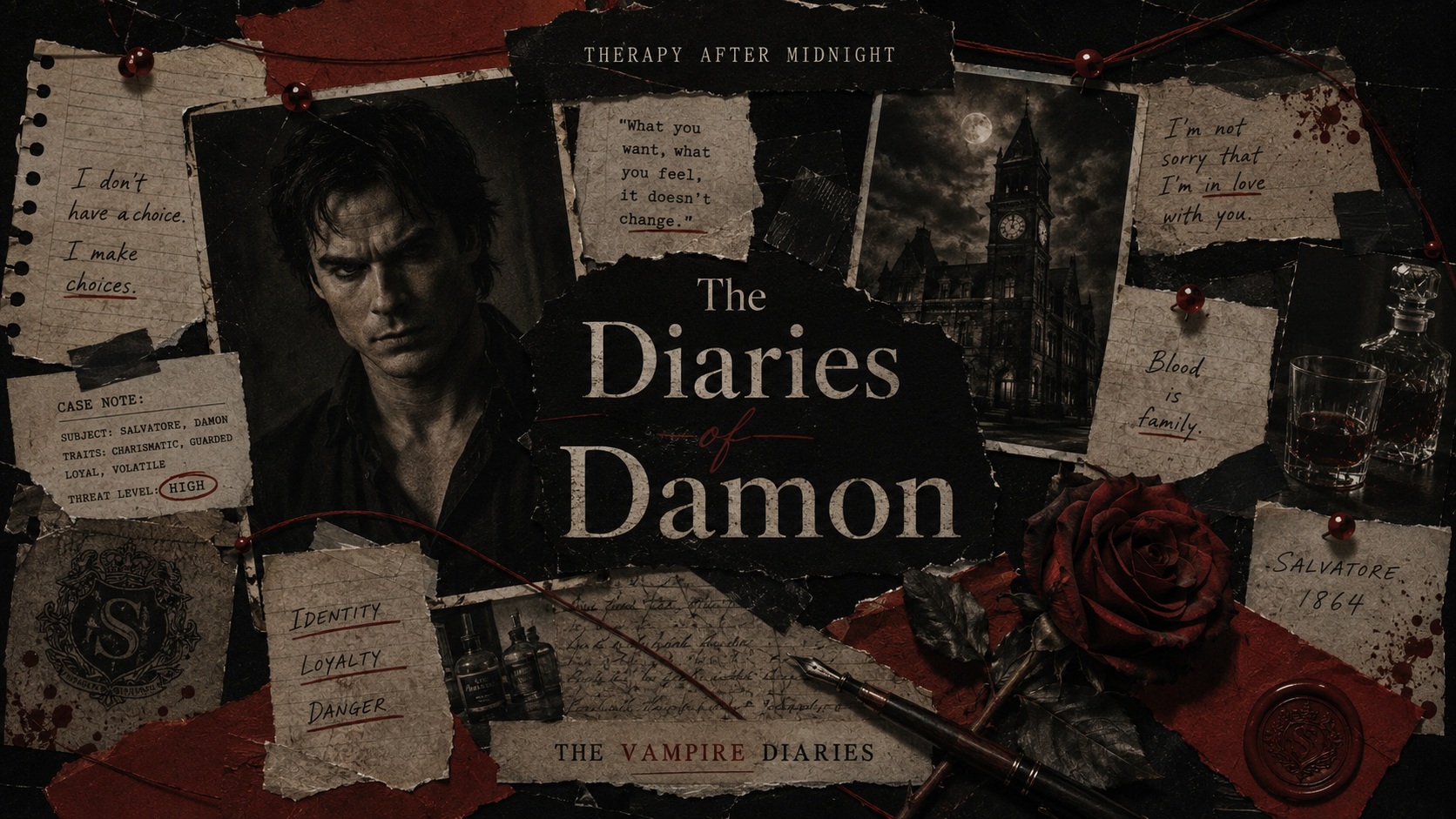
Therapy After Midnight | The Mystic Falls Diaries
Damon Salvatore spends a lot of The Vampire Diaries acting like he already knows what everyone thinks of him.
He is the dangerous brother. The impulsive one. The selfish one. The person most likely to hurt someone and then make a joke before anybody can ask what was happening underneath it.
The interesting question is not whether Damon is secretly good or secretly bad. The show gives us too much evidence for both. The more useful question is what happens when a person builds an identity around being the one nobody expects to be good.
Damon’s Story Starts Long Before Elena
In the television continuity, Damon and Stefan grow up inside a family shaped by control, fear, secrecy, and a father whose treatment of his sons becomes part of the emotional history they carry into vampirism.
Then there is Katherine Pierce. Both brothers become attached to her, both are pulled into the same triangle, and both eventually become vampires. The rivalry that follows is not just about romance. It becomes tied to loyalty, betrayal, resentment, identity, and the question of which brother ruined whose life first.
Damon carries that history for more than a century before the series even begins.
The Bad Brother Role Gives Him Somewhere to Hide
Damon frequently behaves in ways that are violent, coercive, manipulative, and harmful. A psychological lens should not turn those choices into something harmless because we understand more about his history.
At the same time, the role of “bad brother” seems to give Damon a script. If everyone expects the worst from him, he does not have to risk very much by giving them exactly that.
There is a kind of protection in being predictable. Caring creates something to lose. Hope creates the possibility of disappointment. Trying to be better means other people can notice when you fail.
Damon often seems more comfortable being condemned than being vulnerable.
Attachment Does Not Make His Behavior Safe
Damon’s relationships are full of intense attachment. Katherine, Stefan, Elena, Alaric, Bonnie, and others become people whose presence can dramatically change his behavior.
It would be easy to turn that into a diagnosis. I do not think we need to.
We can talk about fear of loss, dependency, rejection sensitivity, jealousy, loyalty, avoidance, control, and grief without deciding that those patterns prove a personality disorder or any other diagnosis.
We also need to keep the ethical line clear: loving someone does not make coercion, violence, threats, or violations of consent acceptable. Explanation and accountability can exist in the same conversation.
The Augustine Years Change the Context
Later seasons reveal another major part of Damon’s history: captivity and experimentation by the Augustine group. The series uses this history to give more context for his distrust, rage, survival responses, and relationship with Enzo.
That is meaningful material for a trauma discussion, but trauma should not become a universal explanation for everything Damon does. Trauma can shape behavior without removing responsibility, and fictional supernatural torture does not map neatly onto one real-world diagnosis.
What Elena Changes, and What She Does Not
Elena becomes one of the strongest forces pulling Damon toward a different version of himself. The show repeatedly asks whether love can make someone better.
I think Damon is more interesting when we resist that simple answer.
Elena gives him reasons to care about consequences he once dismissed. But a relationship cannot do all of someone’s moral work for them. If Damon behaves differently only because one particular person might leave, that is not the same thing as developing a stable internal value system.
Some of his strongest growth happens when the circle of people he cares about expands and when his choices begin to reflect loyalty, grief, friendship, responsibility, and sacrifice beyond one romantic relationship.
Bonnie May Be One of the Most Important Relationships in His Development
Damon and Bonnie begin with very little reason to trust each other. Their relationship changes because they are forced into circumstances where charm and romantic intensity are not enough.
Over time, friendship asks something different from Damon. Bonnie can care about him and still challenge him. She can matter deeply without becoming another version of the romantic triangle that has defined so much of his life.
That makes their relationship useful for looking at repair, mutual influence, accountability, and the difference between being wanted and being known.
So What Would I Diagnose Damon With?
I would not diagnose him from the series.
Damon gives us traits and behaviors that could be pulled toward several diagnostic categories if we started with a label and worked backward. That would ignore the supernatural rules of the story, the enormous span of his life, inconsistent circumstances across eight seasons, the effects of vampirism and compulsion, and the absence of an actual clinical assessment.
I think the richer case file is about identity.
What happens when someone spends so long expecting to be the disappointment that being better starts to feel more dangerous than being exactly who everyone already thinks they are?
Before You Leave Mystic Falls
Think about a character you have watched who repeatedly says, directly or indirectly, “This is just who I am.” Then ask whether the story actually supports that idea, or whether the identity has become a way to avoid the risk of changing.
Return to The Mystic Falls Diaries
Therapy After Midnight looks at fictional characters through a mental health lens. These posts are educational reflections, not actual clinical diagnoses. Fiction does not provide the assessment, history, collateral information, or therapeutic relationship required for diagnosis.
Research notes
- Primary continuity for this draft is the television series The Vampire Diaries, not the original novel continuity.
- Lore areas incorporated into the draft include the Salvatore family history, Katherine and the 1864 storyline, Damon and Stefan’s long rivalry, Damon’s relationship with Elena, Augustine captivity and Enzo, and Damon’s later friendship with Bonnie.
- Clinical framing intentionally focuses on attachment, trauma context, identity, accountability, grief, and relational patterns rather than assigning a diagnosis from fictional behavior.
- Before publication, episode-level citations can be added to the research notes without changing the article’s clinical framing.
Leave a Reply